Why You Should Never Use Your Personal Email for Free Trials
You spot a tool you want to try. The "Start Free Trial" button glows. It asks for your email. You type the same address you have used for a decade, hit submit, and get on with your day. That tiny, two-second action just opened a door you cannot easily close.
I have seen this play out hundreds of times, both in my own inbox and in the inboxes of friends and readers. One free trial turns into ten years of marketing emails. One sign-up ends up sold to a data broker. One forgotten account leaks your address into a breach you never hear about.
The good news? You can keep using free trials without paying that long-term cost. This guide walks you through what actually happens when you hand over your real email, the latest 2025 numbers from the FBI and major outlets, and a simple, hopeful path forward that protects your inbox for years to come.
The Quiet Chain Reaction Behind Every Free Trial
Most people think a free trial ends when the trial ends. It does not. The moment you submit your real email, a long chain of events begins, and most of it runs in the background.
First comes the welcome email. Then the onboarding drip. Then the trial-ending urgency push. Then the win-back sequence. Then the general newsletter, often forever. According to the Radicati Group, the average email user already receives more than 120 messages per day, and a large share comes from services people signed up for once and forgot.
But the noise is only one half of the story. The other half is what happens to your address behind the scenes. Many free trial services share data with advertising partners, analytics tools, and "trusted" third parties listed deep inside the privacy policy. Your real email becomes a key, and that key starts opening doors you never approved.
Here is the question worth asking: how many free trials have you signed up for in the past five years? Ten? Thirty? Fifty? Each one is a small permission slip you signed without reading the fine print, and each one keeps working long after you forget the product even exists.
I once helped a friend audit her inbox on a slow Sunday afternoon. We counted 47 active marketing senders, and she remembered actively using only six of them. The other 41 came from free trials, one-day downloads, and "ungated" PDF reports she barely glanced at years ago. Her inbox was loud, cluttered, and stressful, and the cause was a hundred tiny moments of trust she gave away without noticing.
Your Email Address Is Worth More Than You Think
People treat email like a username. Marketers, hackers, and data brokers treat it like a Social Security number for the internet. The difference matters.
Your email is a persistent identifier. Cookies clear, IP addresses change, and phone numbers get swapped. But most people keep the same email for 10 to 20 years. That makes it the single most reliable way to track a person across websites, devices, and decades. Advertising networks and data brokers all use email as the master link that ties your activity together.
It also unlocks attacks. If a stranger knows your email, they can probe password resets on Gmail, Amazon, and your bank. Even a denied reset reveals which services you use, and that intel fuels targeted phishing later. Verizon's 2025 Data Breach Investigations Report found that stolen credentials and phishing remain among the top entry points for breaches, and 36% of all data breaches involve phishing.
There is one more layer many people miss. Your email is the seed of your digital identity. Lose control of it, and you lose control of the dozens of accounts attached to it. Protect it, and you protect everything downstream.
The 2025 Cybercrime Numbers You Need to See
The trend is not subtle, and the numbers are not dropping. The FBI's 2025 Internet Crime Report, released in early 2026, recorded over $20.9 billion in cybercrime losses, a 26% jump from 2024. The IC3 received more than one million complaints for the first time in its 25-year history.
Phishing was the top complaint category for the year, with 191,561 reports. And here is the part that stings: while phishing complaint counts barely moved, financial losses from phishing tripled from $70 million in 2024 to $215.8 million in 2025. Attackers are getting fewer hits but doing far more damage with each one.
Business email compromise alone caused $3.04 billion in reported losses in 2025. Government impersonation scams nearly doubled to $797.9 million. AI-related cybercrime entered the report for the first time, with over 22,000 complaints and $893 million in losses, fueled by voice clones, deepfake videos, and machine-written phishing emails.
Zoom out further. The Anti-Phishing Working Group recorded around 3.8 million phishing attacks in 2025. According to industry trackers, 2025 logged more than 2,500 publicly reported data breaches by October alone. In one October 2025 incident, roughly 2 billion email addresses were exposed through a leak of stealer-log data, then indexed for searchability.
If your email has been online for more than a few years, statistically, it is already in someone's database. The question is no longer "will it leak" but "how loud will the spam be when it does."
How Free Trials Feed the Data Broker Machine
A data broker is a company that collects, packages, and sells personal information about people who never agreed to be tracked. Their profiles can hold thousands of data points per person, including your email, address, income range, health interests, political leaning, and shopping habits.
How does a free trial sign-up land in those profiles? The path is simple. You sign up. The service shares your data with "marketing partners" buried in clause 14 of the privacy policy. Those partners merge your email with public records, social media activity, and browsing data from other sources. The aggregated profile gets sold to advertisers, recruiters, insurers, and sometimes worse actors.
Norton's LifeLock team notes that nearly 6 in 10 Americans skip privacy policies entirely. So most free trial sign-ups are silent consent to data sharing the user never read. CNBC reported that brokers like Experian, Equifax, LexisNexis, and Epsilon hold detailed dossiers on hundreds of millions of Americans, and a single phone number can unlock a name, address, family ties, and more.
There is some hope on the policy side. California's Delete Act created the DROP platform, which launched on January 1, 2026, and lets residents submit a single deletion request to all registered data brokers. Starting August 1, 2026, registered brokers must check DROP every 45 days and delete matching records within 45 days. Failure to register costs $200 per day, and failure to delete costs $200 per consumer per day.
But here is the catch. New data flows in constantly, deletion is an ongoing chore, and dozens of brokers were caught in 2025 hiding their opt-out pages from Google search results. The cleanest defense is to never hand over your real email in the first place. Prevention beats removal every single time.
Phishing, Credential Stuffing, and the Real Cost of Reused Passwords
Once your email leaks, the real games begin. The first move is usually credential stuffing. Attackers grab the email-and-password pairs from one breach and try them against banks, streaming services, social platforms, and shopping sites. Studies have shown most people reuse passwords across services, so this attack works alarmingly often.
The second move is targeted phishing. Generic phishing is easy to spot. Targeted phishing is not. When the attacker already knows you use Spotify, Adobe, or your local bank, the fake email becomes far more convincing. The Verizon DBIR 2025 reported that the median time for a user to click a phishing link is just 21 seconds. Twenty-one seconds is faster than reading this paragraph.
The damage stacks up quickly. IBM's Cost of a Data Breach Report 2025 puts the average phishing-related breach at $4.88 million for businesses, and IBM also found that breaches take an average of 194 days to even identify. That is more than six months during which your data sits exposed before anyone tells you. For smaller startups, the kind that often run free trials to acquire users, detection is even slower.
Want a simple way to check your exposure? Visit haveibeenpwned.com and search your address. Most people who have used the same email for years find it in three, five, or ten breaches. The Synthient stealer-log dataset added in late 2025 alone contained roughly 183 million unique email-and-password combinations grabbed from infected devices.
So the chain looks like this: you use your real email for a free trial, the service gets breached, your email enters the stuffing database, attackers try your old passwords on dozens of sites, and any reused password becomes a key. One careless trial sign-up turns into a months-long fire drill.
What Actually Happens After Your Email Leaks
Most people imagine a leak as a single dramatic event. In reality, it is a slow drip that lasts years.
Within days, your address often shows up on bulk spam lists sold across Telegram groups and shady forums. Within weeks, it lands in phishing kits used by low-skill attackers running automated campaigns. Within months, it gets bundled with other leaked data into "combo lists" that fuel credential stuffing attacks. And within years, it becomes a permanent line in dozens of broker profiles that get resold quietly across the marketing world.
CNN Business has reported on the Consumer Financial Protection Bureau's ongoing push to rein in the data broker industry, which the agency has called the "surveillance industry" because of how widely personal information moves between unknown parties. The 2025 enforcement wave from California's privacy regulators showed the same pattern: brokers paid fines ranging from $45,000 to $56,600 for failing to register, and one was ordered to stop selling Californians' data altogether.
A practical example brings it to life. Say you signed up for a fitness app trial in 2022. The app got acquired in 2023. The new owner sold the email list to a marketing partner. That partner got breached in 2024. Your address ended up in a leaked dataset, scraped by data brokers, and sold into ad networks. By 2025, you started getting weight-loss spam, sketchy supplement offers, and the occasional phishing email pretending to be from your gym. None of it traces back cleanly to that one 2022 sign-up, which is why the problem feels so invisible and so hard to fix.
This is why prevention matters far more than cleanup. Once your address is in the system, getting it out is a 47-minute-per-broker chore (according to data privacy researchers cited by CNBC), and the data often reappears on the same sites later because brokers can repopulate from new sources. Stopping the leak at the sign-up form is dramatically easier than chasing it through the data economy afterward.
Why the Gmail "+" Trick Doesn't Actually Protect You
A lot of privacy guides recommend the Gmail plus trick, where you sign up as [email protected] instead of [email protected]. It sounds clever, and it does help with filtering inside your inbox. But for real privacy, it falls apart.
The plus tag does not hide your real address. Anyone reading [email protected] can see your true address is [email protected]. The tag is also trivial to strip. Spammers run a one-line script that removes everything between the plus sign and the at symbol. Many sign-up forms also reject the plus character entirely, which forces you back to the real address anyway.
Same problem with using a second Gmail account just for trials. You still get tracked, still leak in breaches, and still drown in newsletters. You just moved the mess from one account to another, and you doubled your password management work.
The deeper issue is structural. Both tricks attach the trial sign-up to an account that you also use for real life. They mix your personal identity into a stream of low-trust services. Once those services leak, the leak ties back to you.
What a Real Solution Looks Like: Temporary Email
Here is the shift that changes everything. Instead of using your real email for low-trust services, you use a temporary email address that you can throw away the moment you are done.
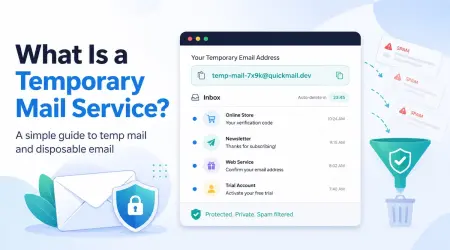
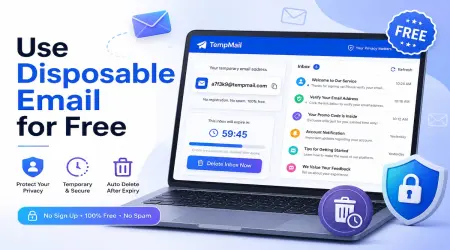
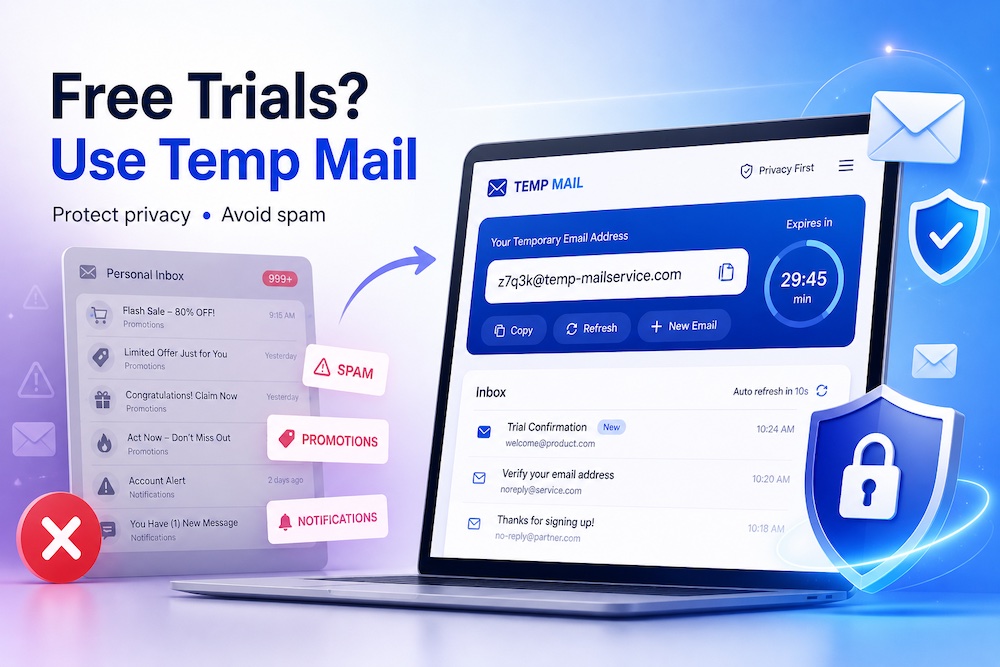
A temporary email is exactly what it sounds like. It is a real, working inbox that lives for a short window of time. You can receive verification codes, click confirmation links, and complete a free trial just like you would with a normal address. Then, when the trial ends or the marketing emails start, you walk away. The address self-destructs and so does every breach risk attached to it.
Temporary email services like temporarymailservice.com solve the free-trial problem at the root. There is no long-term identifier for marketers to track. There is no password tied to your real life if the service gets breached. There is no inbox to clean up six months later when the win-back campaigns start.
For people who want a longer-term version, email aliases are a step up from temp mail. An alias is a unique address that forwards to your real inbox but never reveals it. You can disable an alias the moment it gets spammy and your real address stays untouched.
Both options share the same core philosophy. Your real email is for people. Temporary emails and aliases are for services. Once you internalize that single rule, your inbox starts to heal almost immediately.
There is also a subtle benefit most people miss. A temporary email creates a clean audit trail in your own head. If you only used a temp address for a service, and now you are getting spam at your real inbox claiming to come from that service, you know instantly the email is fake. The mismatch becomes a built-in phishing detector. That tiny shift in clarity is worth its weight in gold the first time it saves you from clicking a convincing scam.
How to Use a Temporary Email for Free Trials, Step by Step
The process is simpler than most people expect. You can do it the first time in under a minute, and after that it becomes muscle memory.
Step one: open a temporary email service in a new browser tab. A free, no-signup option like temporarymailservice.com gives you a working address instantly. Copy the generated address.
Step two: paste that address into the free trial sign-up form. Set a strong, unique password using a password manager. Never reuse a password from another account, even for a trial you plan to delete.
Step three: head back to the temporary inbox and look for the verification email. Click the confirmation link or enter the code. Most services accept temp addresses without issue.
Step four: enjoy the trial. Use the product the same way you would with your real email. The verification, password resets, and notifications all land in the temporary inbox.
Step five: when the trial ends, walk away. Do not unsubscribe, do not click anything, do not stress. The address fades on its own and any spam tied to it goes with it.
For services you decide to keep paying for, switch to an email alias instead of your real address. That gives you long-term access without exposing your primary inbox.
When It Is Actually OK to Use Your Real Email
Temp mail is a tool, not a religion. Some accounts deserve your real address, and treating every sign-up the same way creates problems too.
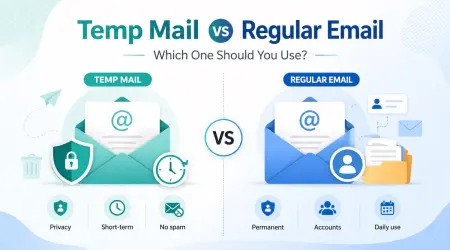
Use your real email for your bank, brokerage, and other financial accounts. Recovery for those needs your most stable, trusted address. Use it for your employer, school, healthcare provider, government portals, and anything tied to legal identity. Use it for close family and friends who want to actually reach you.
Use a temporary or alias address for free trials, one-time downloads, newsletters, sweepstakes, online shopping at unfamiliar stores, forums, beta apps, and anything that smells like a marketing funnel. If losing access to the account would not cost you anything serious, the temp route is the right call.
A simple rule covers 95% of cases: if a real human will email you from this account, use your real address; if a brand will market to you, use a temporary one. Apply that one rule for a year and your inbox will be unrecognizable.
Building a Privacy-First Habit That Lasts
Privacy is not a single big upgrade. It is a stack of small habits that compound. The free trial habit is one of the highest-impact pieces, because trials are everywhere and the cost of one bad sign-up echoes for years.
Start with three small commitments. First, never paste your real email into a free trial again, no matter how rushed you feel. Second, install a password manager and use it for every account, even the throwaway ones. Third, run your real address through haveibeenpwned.com once a quarter and rotate any password that shows up in a new breach.
Add a fourth habit if you want to go further. Once a month, scroll through your real inbox, find any service you no longer use, and either delete the account or unsubscribe completely. Lighter inboxes are healthier inboxes, and fewer accounts mean fewer attack surfaces.
Has any of this ever felt overwhelming to you? It does not have to be. Each step takes minutes, not hours. The goal is not perfect privacy. The goal is steady progress that puts you back in charge of your own data.
That last part matters most. Privacy is not about fear. It is about control. The fear story says you have already lost, so you might as well give up. The control story says you can take back ground every week with small, calm actions. The control story is the true one.
Common Questions People Ask Before They Switch
A few honest questions come up every time I walk someone through this approach. Let me answer them directly.
Will free trial sites block a temporary email?
Some will, and some will not. Many big brands run loose checks and accept temp addresses without issue. A few SaaS platforms block known temp domains, especially for paid tier sign-ups. If one service blocks a temp address, switch to an email alias from a privacy-focused alias provider, which uses standard email infrastructure that almost never gets flagged.
What if I want to convert the trial into a paid plan later?
For anything you might keep paying for, use an email alias instead of a temp inbox from the start. An alias forwards mail to your real inbox forever, so you keep long-term access without exposing your real address. If you started with a temp inbox and now want to keep the service, contact the company's support and ask to update the email on file.
Is using a temporary email against terms of service?
A working email address is a working email address. Temp inboxes and aliases are real, valid email systems, not fake fields. You are providing a legitimate way to receive communications, which is what the service actually requires. The privacy layer is yours to manage.
Will I miss important emails?
Only if you ignore the temp inbox during the trial. Keep it open in a tab while you complete sign-up, password setup, and any verification flows. Once those are done, the trial period itself rarely needs the inbox unless you are watching for renewal notices.
How does this affect my password manager?
Add the temp address and the unique password to your manager just like any other entry. If the service becomes long-term, update the email field later when you switch to an alias or a permanent address.
The Path Forward Is Yours
Here is what I want you to walk away with. Free trials are not the enemy. They are useful, they are convenient, and most of the products behind them are legitimate. The enemy is the lazy default of using your real email for every sign-up, which turns a simple convenience into a long-term liability.
You now have the full picture. You know what happens behind the curtain after a sign-up. You know the 2025 numbers from the FBI, the breach trackers, and the data broker enforcement actions. You know why the Gmail plus trick is not enough. And you know there is a clean, free, almost effortless alternative waiting in your browser.
The shift takes about 30 seconds. Open temporarymailservice.com in a new tab the next time a "Start Free Trial" button stares back at you. Use the temporary address. Finish the trial. Walk away clean. Then do the same on the next trial, and the one after that, and after a few months you will notice your real inbox is calmer than it has been in years.
You do not have to wait for new privacy laws. You do not have to delete yourself from the internet. You do not have to learn a complicated new tool. You just have to make one small swap, every time, and let the compounding work in your favor.
Your email is yours. Your attention is yours. Your time is yours. Free trials should serve you, not collect you. From this point on, they can.
Helpful next step: bookmark a temporary email service today, and the next time you spot a "free trial" button, you will be ready in seconds. Small habit, lifelong payoff.